
Get updates on new courses, exclusive events, early enrollment access, and expert wine insights.
- New course announcements
- Early enrollment access
- Exclusive wine events
- Wine and spirits education insights
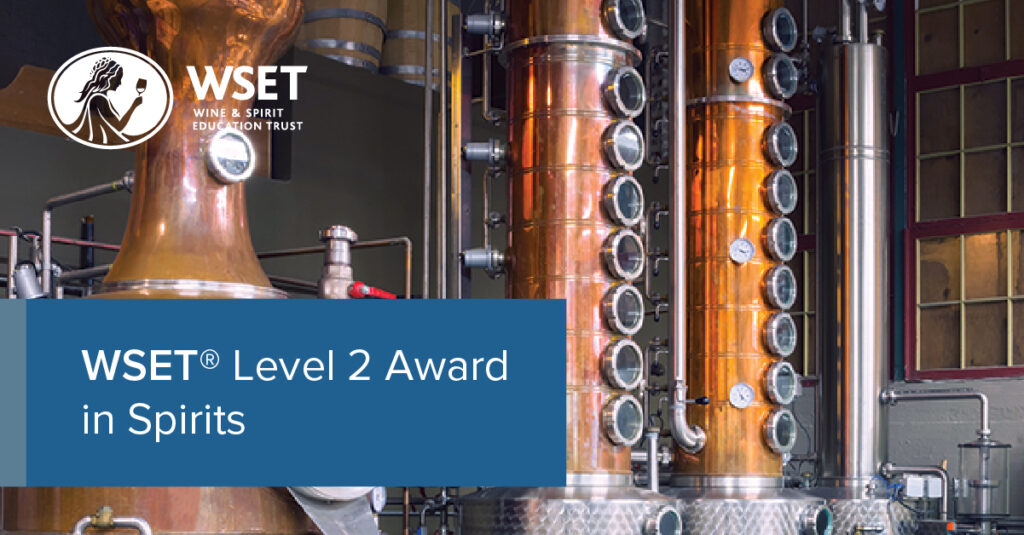
The WSET Level 2 Award in Spirits is for anyone who wants to build real depth in the major spirits categories, how they’re made, and how to serve them. This qualification covers the production factors that shape style and quality, the principal types of spirits and liqueurs, flavored spirits and aromatized wines, and the principles behind a balanced cocktail.
Throughout the course, you’ll develop analytical tasting skills using the WSET Level 2 Systematic Approach to Tasting Spirits® (SAT), learning to evaluate a spirit’s appearance, nose, palate, and quality across a wide range of styles. In addition, you’ll examine how key raw materials and production choices influence the finished spirit, so you can speak about what’s in the bottle with accuracy and confidence.
In short, the WSET Level 2 Award in Spirits gives hospitality and retail professionals (and serious enthusiasts) a credible, globally recognized foundation for working with spirits every day.
Prerequisite: None. A genuine interest in spirits is all you need to begin.
Our online Level 2 Spirits course runs through the WSET Online Classroom, a structured digital learning environment with video lessons, module activities, end-of-module quizzes, and practice exam questions. Specifically, you’ll work through the material at your own pace, with educator support available throughout the 5-week support window to answer questions and help you prepare for the exam.
In short, this format suits working professionals and enthusiasts who want a rigorous spirits qualification without rigid scheduling. When you’re ready, you’ll schedule your online exam via Remote Invigilation at a time that works for you.
Tasting and evaluating spirits
First, you’ll learn to taste systematically using the WSET Level 2 Systematic Approach to Tasting Spirits® (SAT), evaluating appearance, nose, palate, and quality level. As a result, you’ll build a consistent tasting vocabulary you can apply to any spirit you encounter.
Factors determining the style and quality of spirits
Next, you’ll examine the key stages of spirits production: raw materials, fermentation, distillation in pot stills and column stills, and post-distillation maturation and finishing. In particular, you’ll learn how each choice shapes strength, aroma, flavor, and overall quality in the finished spirit.
Fruit spirits, including Cognac and Armagnac
Additionally, you’ll study how Cognac, Armagnac, Calvados, and other fruit-based spirits are produced, aged, and labeled, including the defined regions, distillation methods, and age statements that shape their styles.
Whisky and whiskey
In addition, you’ll explore the principal styles of Scotch whisky, Irish whiskey, American whiskey (Bourbon, Tennessee, and Rye), and other world whiskies, along with the key production choices and labeling terms that distinguish each category.
Rum, Cachaça, Tequila, and Mezcal
Then, you’ll look at how rum and Cachaça come from sugar cane, how Tequila and Mezcal come from agave, and how production choices (including still type, ageing, and region of origin) lead to the distinct styles available today.
Vodka, flavored spirits, and aromatized wines
Also, you’ll cover vodka, gin, flavored vodkas, liqueurs, bitter spirits, and aromatized wines like Vermouth, learning the defining characteristics and production methods that separate one style from another.
Cocktails and the service of spirits
Finally, you’ll learn the principles behind a balanced cocktail (the scales of strong vs. weak and bitter/sour vs. sweet), name the core cocktail families, and cover best practices for the storage, service, and food pairing of spirits behind any bar.
Overall, the WSET Level 2 Award in Spirits requires approximately 26 hours of total qualification time. This breaks down into 15 hours of guided learning (video lessons, activities, and the 1-hour exam) and 11 hours of private study.
Because this is a self-paced online course, you can spread that time across the 5-week course window however best suits your schedule.